Plate solving, explained
Plate solving is how software works out exactly which part of the sky a photo shows. Here is what it gives you, how a blind solver does it without any hints, and what SkySolver adds: any field from a telescope frame to a 360° panorama, photos of the Moon, and answers in milliseconds.
What plate solving gives you
A solved photo has an exact address on the sky. The solution gives the sky coordinates (right ascension and declination) of its centre and corners, its scale in arcseconds per pixel, its rotation, its field of view, whether it is mirrored, and the lens distortion. Astronomy software stores it as a World Coordinate System (WCS) in the image's FITS header, which PixInsight, Siril, ASTAP, DS9 and astropy all read.
With it you can label the objects in the photo, run colour calibration that needs a solution (such as PixInsight's SPCC), build mosaics, sync a telescope mount to where it really points, find a comet or an asteroid, or measure positions on the sky.
Hinted and blind solving
A hinted solver starts from approximate coordinates and an image scale, from the telescope mount or the file's header, and searches only near them: fast when the hints are right, lost when they are wrong or missing. A blind solver needs no hints at all: it searches the whole sky at any scale, rotation and mirroring. Astrometry.net made blind solving practical in 2010; SkySolver is a blind solver too, built for speed and for the photos other solvers give up on.
How a blind solver finds the field
- Detect. The stars in the photo are found and measured: their positions to a fraction of a pixel and their brightness. In SkySolver this happens in your browser, with WebAssembly.
- Hash. Every four neighbouring stars make a quad. Five ratios of their distances form a code that stays the same whatever the scale, rotation or mirroring of the photo.
- Match. The codes are looked up in an index built in advance from a star catalogue: SkySolver's holds 13.1 million quads from ESA's Gaia DR3 catalogue, at every scale from the whole sky down to fields of a fraction of a degree.
- Verify. A matching code is only a candidate. It is checked against hundreds of other stars: a chance match would leave them unexplained, a true one predicts where each of them is.
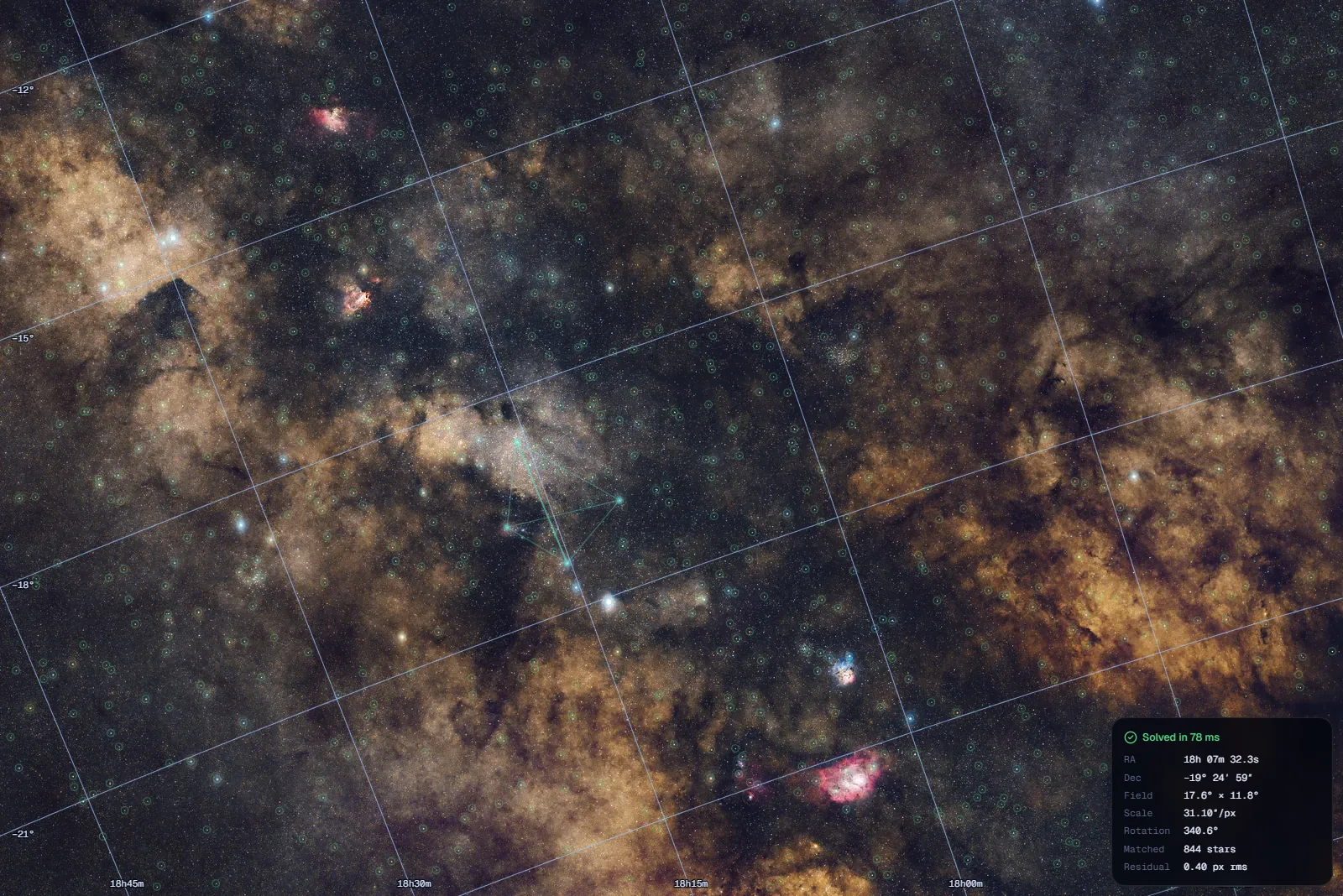
- Fit. The matched stars give the solution: the centre, scale and rotation, with the lens distortion as a polynomial (TAN-SIP). The photos on SkySolver's home page took 48 ms on average.
Wide fields, panoramas and distortion
Most solvers assume the photo is a flat, rectilinear view of the sky with a little distortion. Fisheyes, stitched panoramas and little planets break that: their scale changes across the frame, so the star patterns no longer match the catalogue's. SkySolver tries the projections such images use (equirectangular, Mercator, cylindrical, Panini, stereographic), fits a projection model with a correction grid on top, and masks out the landscape, trees and reflections in the frame. That is how it solves a 360° Milky Way panorama, in seconds.
Solving the Moon
A photo of the Moon has no stars to match, so SkySolver's Moon solver matches the Moon itself. It finds the disk's edge (its centre and radius), then the terminator, which gives the Sun's direction and the phase. Then it compares the photo with maps of the Moon's albedo and slopes at every rotation, both mirrorings and a grid of librations at once, with Fourier transforms, and keeps the answer only if it explains the photo far better than the runner-up. From then on every pixel has its selenographic coordinates, and the craters can be named. It needs no date, place or marked craters, only the photo: see the Moon solver.
What SkySolver adds
- Always blind: no coordinates, scale or orientation, and mirrored images too.
- Any field: from narrow telescope frames to fisheyes and 360° panoramas, with landscape in the frame.
- Photos of the Moon, from a small Moon above the landscape to a telescope close-up a few hundred kilometres across.
- Fast: tens of milliseconds for a typical photo, and no account to make.
- Private: only the stars' positions leave your browser.
- In your tools: a PixInsight plugin, a free API, and an Astrometry.net-compatible API for N.I.N.A., KStars and others.
Further reading
- Lang, D., Hogg, D. W., Mierle, K., Blanton, M. & Roweis, S. (2010). Astrometry.net: blind astrometric calibration of arbitrary astronomical images. The Astronomical Journal 139, 1782.
- Gaia Collaboration, Vallenari, A. et al. (2023). Gaia Data Release 3: summary of the content and survey properties. Astronomy & Astrophysics 674, A1.
- Calabretta, M. R. & Greisen, E. W. (2002). Representations of celestial coordinates in FITS. Astronomy & Astrophysics 395, 1077.
- Shupe, D. L. et al. (2005). The SIP convention for representing distortion in FITS image headers. ASP Conference Series 347, 491.