Telescope frames
Fields down to 0.3° across, and to 0.1° around 2,462 small galaxies, planetary nebulae and globular clusters. The solution goes into a FITS WCS header for your processing software.
Drop a photo of the night sky, from a telescope frame to a 360° panorama. SkySolver works out exactly where it points, usually in milliseconds, then draws the grid, the constellations and 20,543 nebulae, clusters and galaxies onto it. Your photo never leaves the browser; only its stars do.
No coordinates, no field of view, no hints. SkySolver recognises the patterns of the stars in your photo and works out exactly which piece of sky it shows, lens distortion included, in a few tens of milliseconds.
The solver's own run on this photo of Sagittarius, replayed: 3,410 stars detected, 844 matched.
Telescope or phone, a single galaxy or the whole Milky Way: SkySolver needs no hints about what you photographed. It solves blind, at any scale, rotation and mirroring, and in milliseconds for most photos.
Fields down to 0.3° across, and to 0.1° around 2,462 small galaxies, planetary nebulae and globular clusters. The solution goes into a FITS WCS header for your processing software.
Lenses from fisheye to telephoto, and phones too. Trees, mountains and reflections in the frame are masked out, and the lens distortion is fitted.
Stitched Milky Way arches, 360° panoramas and little planets, each solved in its own projection: equirectangular, Mercator, cylindrical, Panini or stereographic.
Solved blind as well, from the photo alone: from a small Moon above the landscape to a telescope close-up a few hundred kilometres across, it finds the disk, the phase and the libration, then names 6,971 features.
Solve a Moon photoPoint at anything on the solved photo for its names, type, size and catalogue numbers: 20,543 nebulae, clusters and galaxies, the named stars, and the planets, asteroids and comets of the moment it was taken.
Tens of milliseconds for a typical photo, and no account to make. Your browser finds the stars itself and sends only their positions; the photo stays with you.
The solved photo becomes a map: the grid, the constellations and 20,543 nebulae, clusters and galaxies from the Messier, NGC, IC, Sharpless, Barnard, Lynds, van den Bergh, Collinder, RCW, Arp and Abell catalogues, with their real outlines, not just circles, and the named stars.
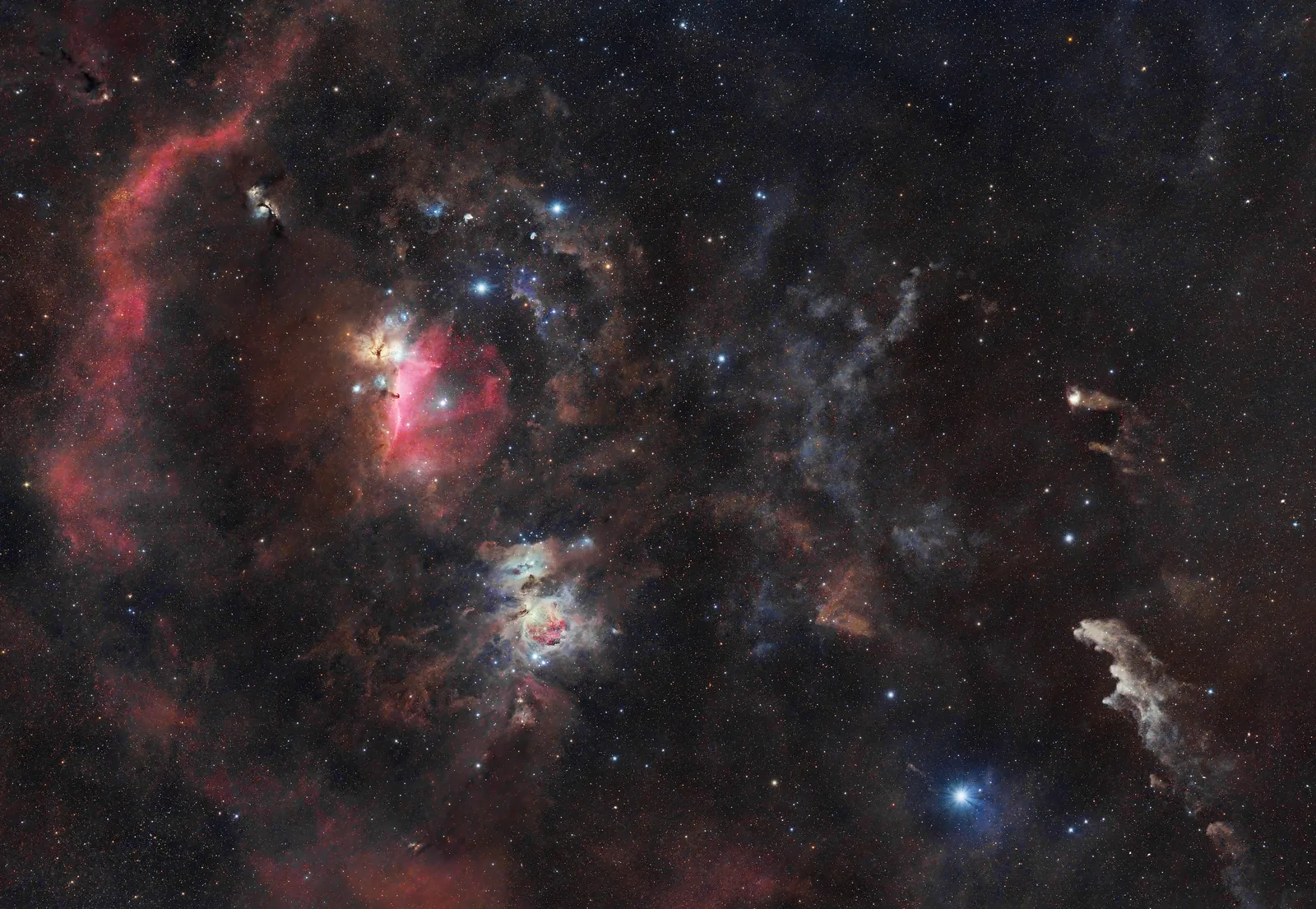
Orion, from Barnard's Loop to the Witch Head, annotated by the playground's own overlay code.
Show only what matters for your photo, find any object in a click, and style every layer: colours, thickness and line styles for each object type or catalogue. The legend follows, and your choices are remembered.
The same blind solver and the same annotations, as scripts for PixInsight: solve and annotate without leaving the editor you process your photos in.
The same solver and annotations over HTTP: send a photo, or just its stars, and get back where it points; then an annotation to draw over it. No account, no key.
{
  "image": "/9j/4AAQSkZJRgABAQEASABIAAD/2wBDAAYEBQYF…"
}{
"solved": true,
"center": { "ra": 271.8847813, "dec": -19.41631804 },
"scale_arcsec": 31.10274612,
"rotation_deg": 340.6277773,
"fov": { "width_deg": 17.58690697, "height_deg": 11.80944417 },
"wcs": {
"ctype": "RA---TAN-SIP",
"crval": [271.8847813, -19.41631804],
"crpix": [1023.5, 683], "cd": [[…], […]], "sip": { … }
},
"capture": { "time": …, "location": … },
…
}Plate solving, or astrometric calibration, is working out exactly which piece of the sky a photo shows: the sky coordinates (right ascension and declination) of its centre, its scale, its rotation and its field of view. A solver finds them by matching the patterns of the photo's stars against a star catalogue; a blind solver needs no hints to start from. SkySolver solves blind, then draws everything it knows about that piece of sky over the photo. More in Plate solving, explained.
An ordinary photo is solved in a few tens of milliseconds on our server: the three star photos on this page took 48 ms on average. Stitched panoramas and other unusual projections take a few seconds. There is no account to make, and your browser finds the stars while it opens the photo, so the answer is usually there almost at once.
Photos of the night sky from any camera: telescope frames down to about 0.3° across (0.1° around small galaxies and nebulae), wide fields from camera lenses and phones, fisheyes, and stitched panoramas up to the whole sky in equirectangular, Mercator, cylindrical, Panini, stereographic or little-planet projection, with trees, mountains or reflections in the frame, mirrored or not. And, with a solver of their own, photos of the Moon.
Yes. The solved photo gets the coordinate grid, the 88 constellations, 20,543 nebulae, star clusters and galaxies from the Messier, NGC, IC and a dozen other catalogues, drawn to their real shapes, and the named stars; given the capture time, also the Sun, the Moon, the planets, asteroids and comets. Point at any object for its names, type, size and catalogue numbers: a way to learn the sky from your own photos. Step by step: identify the stars in your photo.
Yes, blind as well: the photo is all it needs, no date, place or marked craters. From the whole disk to a telescope close-up a few hundred kilometres across, and from a crescent to a small Moon above a landscape, it finds the disk, the phase and the libration, then names 6,971 craters, maria, mountains and rilles over the photo. A single crater filling the frame is at the edge of what it can do. Solve a Moon photo.
It is free, without an account, a key or ads: the web tool, the PixInsight plugin and the API.
Not for the stars: your browser finds the stars in the photo itself, with WebAssembly, and sends the solver only their positions. A Moon photo is solved from a greyscale copy at most 2048 pixels across, which the solver forgets as soon as it has answered. Nothing is stored and nothing is logged: see privacy.
JPEG, PNG (8 or 16 bit), TIFF (8, 16 or 32 bit), FITS, XISF, WebP, AVIF, GIF, BMP, TGA and PSD, as many at once as you like: they are solved one after another.
The sky coordinates of the centre and the corners, the scale in arcseconds per pixel, the rotation, the field of view and the lens distortion. To take away: a FITS WCS header that PixInsight, Siril, ASTAP, DS9 and astropy read, your FITS file with the solution in its header, your photo with AVM metadata for WorldWide Telescope and Aladin, the annotated photo, the annotation alone as PNG or SVG, the matched stars and the objects in the frame as CSV, and the whole solution as JSON.
For PixInsight there is a free plugin: it solves and annotates on your own computer and writes PixInsight's own astrometric solution. Programs that plate solve online through Astrometry.net, such as N.I.N.A., KStars/Ekos, CCDciel, AstroImageJ and astroquery, can use SkySolver by changing one address: see the Astrometry.net-compatible API.
Your browser measures thousands of stars in the photo. Every four neighbouring stars make a quad, whose shape gives a code that ignores scale, rotation and mirroring. The codes are looked up among 13.1 million quads built from ESA's Gaia DR3 star catalogue; a match is checked against hundreds of other stars, and a fit with the lens distortion gives the solution. Watch it solve.
The stars from ESA's Gaia DR3 and Hipparcos catalogues, the deep-sky objects from OpenNGC, SIMBAD and VizieR, the Moon's features from the IAU's planetary nomenclature with relief from NASA's LRO LOLA, the planets from VSOP87 and JPL Horizons, and the asteroids and comets from the Minor Planet Center. The full credits are at the foot of every page.
Drop it in and see where it points: JPEG, PNG (8 or 16 bit), TIFF (8, 16 or 32 bit), FITS, XISF, WebP, AVIF, TGA or PSD, as many as you like, solved one after another.
Try it out